Lesson 28. interface or type
Mission link: Choosing interface or type is a decision every reviewer eventually challenges, and owning a codebase means answering with the one difference that decides it rather than a list of preferences.
Primary source: Declaration Merging, TypeScript Handbook
Prerequisites: Lesson 11, Lesson 26
Warm-up
- ▢ Lesson 11 showed
interface Named { name: string }andtype Named2 = { name: string }assignable to each other, since assignability compares members rather than names. Given that, dointerfaceandtypediffer almost everywhere, or almost nowhere?
Check
Almost nowhere. The compiler checks shapes, not the keyword that introduced them, so this is mostly one feature with two spellings. The few real differences are what this lesson is about.
Know this
Most of the difference is imaginary
Both interface and type describe an object shape, checked structurally by lesson 11's rule regardless of keyword, erased completely by run time, and able to take a type parameter exactly as lesson 26 describes for a function. Both can be extended, interface with extends and type with &, and one can even extend the other:
type A = { a: number };
interface B extends A { b: string }
This compiles: an interface and a type alias of an object type are one shape wearing two keywords, and lesson 11's rule looks at the shape, not the keyword. Clearing this away leaves a short list of real differences, and only one of them decides most cases in practice.
The difference that decides most cases
Build a type by extending another and get a member wrong, and the two forms disagree about when you find out.
interface A { a: number }
interface B extends A { a: string }
error TS2430: Interface 'B' incorrectly extends interface 'A'.
  Types of property 'a' are incompatible.
    Type 'string' is not assignable to type 'number'.
Rejected at the declaration, naming the property and both conflicting types. The equivalent with type and & compiles.
type A = { a: number };
type B = A & { a: string };
No diagnostic. & composes rather than checks, and where both sides claim a property, that property's type is the intersection of the two claims: number & string has no inhabitants, so B's a becomes never, and the declaration has nothing wrong with it to report. The trouble surfaces only once something builds a value.
const b: B = { a: 1 };
error TS2322: Type 'number' is not assignable to type 'never'.
A string gives the identical shape of error. This never is not lesson 23's exhaustiveness guard, written on purpose to prove every case of a union was handled; this one arrives uninvited, forced onto a property two conflicting declarations both claimed, and it tells you, late and from the wrong place, that the type cannot be constructed. interface extends reports a conflict where you wrote it; & reports it later, at whichever call site first builds a value, as a never that gives no hint an intersection caused it.
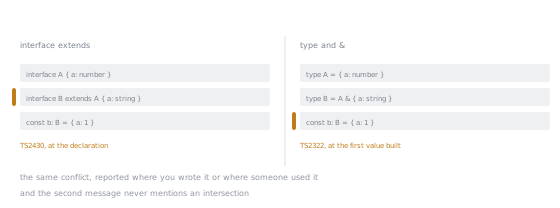
The third line is the same in both panels. Only the marker moves, and where it lands is how far the mistake travels before anyone hears about it.
Declaration merging, and its one real use
Two interface declarations with the same name do not conflict; they merge.
interface I { a: number }
interface I { b: string }
const v: I = { a: 1, b: "x" };
Compiles, and v needs both members. The same pattern with type is refused outright.
type T = { a: number };
type T = { b: string };
error TS2300: Duplicate identifier 'T'.
A type alias binds a name once; a second binding is a redeclaration, not a contribution. This is the mechanism behind module augmentation, and the reason it exists. Given export interface Config { host: string } in one module, a second module can add to that Config without owning the first:
// extra.ts
declare module "./base.js" {
  interface Config { port: number }
}
import { Config } from "./base.js";
const c: Config = { host: "a", port: 1 };
Compiles across the two files, and Config now needs both members. This is why a library's public types are usually interfaces: a consumer can widen a shape the library owns without forking it. It cuts both ways: a type you did not want extended can be extended the same way, invisibly, away from the declaration that introduced it.
What only a type can do
A type alias can name anything, including things that are not object shapes.
type U = string | number;
Compiles. The equivalent as an interface has no syntax at all.
interface I = string | number;
error TS1005: '{' expected.
interface expects a body of members after the name; it cannot say "one type or another." The same limit rules out a tuple, a plain primitive alias, and, once stage 6 introduces them, a conditional or mapped type: none is an object shape. This usually settles the choice before the extension question above even comes up: if what you are naming is not a shape, type is not preferred, it is the only option.
The decision rule
Four lines, in order; the first that applies wins.
- If the type is not an object shape, say a union or a tuple, it must be a
type, becauseinterfacehas no syntax for it. - If it is public and other code may need to add to it later without your involvement, prefer
interface, since onlyinterfacemerges, including declarations written elsewhere via augmentation. - If you are building it by extension and want a conflict caught where you introduced it, prefer
interface extendsover&. - Otherwise either works, and matching what the codebase already does matters more than the choice itself.
A review comment asserting one is always correct is wrong on its face: rule 1 forces type where rules 2 and 3 cannot reach, and rules 2 and 3 favour interface where rule 1 never touches. The useful comment names which line applies, "this needs to merge across modules, make it an interface", a claim a reviewer can check, rather than a preference.
Closing stage 4
Lesson 22 narrowed a discriminated union so each branch sees only its own members, against optional fields describing states the domain does not have. Lesson 23 made the compiler enforce their absence, a never failing by name when a case is unhandled, a different never from the one this lesson produced by accident. Lesson 25 branded a value once its invariant was established, so the type carries proof a check ran. Lesson 26 parameterised a function so the caller's own type returns rather than being widened away. Lesson 27 checked a literal without losing the narrower type actually written. That is the completion criterion this stage opened with: illegal states are unrepresentable, and the compiler proves it. Stage 5 changes the ground under it: every guarantee above assumes a value already has the shape its type claims, and a value arriving from outside the program, a network response, a file, a command-line argument, has not earned that claim yet.
Practice
-
▢ Predict the exact diagnostic, with its
TSnumber.interface A { a: number } interface B extends A { a: string }
Check
error TS2430: Interface 'B' incorrectly extends interface 'A'., with a further line naming a and saying string is not assignable to number. The conflict is caught at the declaration of B.
-
▢ Predict whether the declaration below produces an error, and if it does not, predict the exact diagnostic on the line after it.
type A = { a: number };
type B = A & { a: string };
const b: B = { a: 1 };
Hint
Ask what number & string reduces to, since that is what B's property a becomes.
Check
No error on the declaration. B's a is number & string, and nothing is both, so the property's type is never. The assignment fails with error TS2322: Type 'number' is not assignable to type 'never'., reported at the construction site rather than at the declaration that caused it.
-
▢ Predict whether this compiles, and what happens if both declarations used
type Shape = ...instead.interface Shape { area: number } interface Shape { color: string } const s: Shape = { area: 4, color: "red" };
Check
Compiles as written: the two interface Shape declarations merge, needing both area and color. With type instead, the second declaration is a redeclaration rather than a contribution, and the compiler reports error TS2300: Duplicate identifier 'Shape'. on both.
-
▢ Predict whether
extra.tscompiles, givenexport interface Config { host: string }inbase.ts.// extra.ts declare module "./base.js" { interface Config { port: number } } import { Config } from "./base.js"; const c: Config = { host: "a", port: 1 };
Check
Compiles. The declare module block augments the Config interface base.ts exports, adding port, and the merge applies wherever Config is used afterwards, so a value needing both members satisfies it. Writing Config as a type alias in base.ts would remove this option, since a type cannot be added to from another file.
- ▢ A pull request adds
export type Result<T> = { ok: true; value: T } | { ok: false; error: string };. A reviewer comments, "always useinterface, it reads clearer." Is that correct, and what should they have said instead?
Check
Wrong, and not just a matter of taste: Result<T> is a union of two shapes, not one, so interface Result<T> = ... is not even valid syntax. Rule 1 settles this before rule 2 or 3 is reached. A useful comment would ask whether Result needs augmenting from elsewhere, which a union returned from a function normally does not, rather than assert a blanket preference this example already contradicts.
Real-world reps
- [ ] Search a codebase you work in for a
typebuilt with&over another named type, and check whether a member could conflict; if the compiler stays silent, construct a value and see whether a property comes back typednever. - [ ] Find a public
interfacein a library you depend on and check its declaration files for more than one declaration of that name, evidence that something is using module augmentation to add to it. - [ ] Tomorrow: pick one
interfaceortypechoice in code you own, apply the rule from this lesson, and write the one sentence you would give a reviewer who challenges it.
Going further
- Declaration Merging, TypeScript Handbook: the primary source, including the module augmentation pattern this lesson verifies across two files
- Object Types, TypeScript Handbook: the handbook's own treatment of
interfaceandtypeas two spellings of an object shape - Resources
Not landing? Reread the primary source at the top, since this lesson compresses it and compression is where understanding leaks. Check the glossary for any term that felt slippery.
If the lesson itself is unclear rather than the material, that is a defect: open an issue.