Lesson 33. Errors as Values
Mission link: Owning a codebase means a caller should be able to see, from a return type alone, that an operation can fail, rather than finding out from a stack trace at the moment it least suits you.
Primary source: Introduction, TypeScript Handbook
Prerequisites: Lesson 31, Lesson 23
Warm-up
- ▢ Lesson 17 told you that a value caught in a
catchclause is typedunknown, neverany, because JavaScript can throw anything at all, and that writingcatch (e: string)is refused outright. Predict what happens if you writecatch (e) { const message: string = e; }understrict, and separately predict the diagnostic fromcatch (e: string).
Check
The assignment fails with error TS2322: Type 'unknown' is not assignable to type 'string'., since e is unknown and nothing has narrowed it. The annotation attempt fails with error TS1196: Catch clause variable type annotation must be 'any' or 'unknown' if specified. Both are lesson 17's fact, seen again from the angle this lesson needs: a caught value carries no information about what it is, only that something was thrown.
Know this
Why a thrown error is invisible to the type system
A function's type is its parameters and its return type, and a throw appears in neither.
function fail(message: string): number {
  throw new Error(message);
}

const n: number = fail("boom");
console.log(n);
This compiles clean under strict. fail's type is (message: string) => number, exactly as if it returned a number, because a signature has no place to record that the body never returns. Run it and the truth shows up only at run time:
Error: boom
    at fail (.../fail.js:4:11)
The process crashes uncaught, nothing beforehand having shown it coming. A parseAge that returns number for a good string and throws for a bad one types the same way, (raw: string) => number, no hint of failure in the signature either way. This is the gap lesson 17 left open: unknown on a catch variable is honest about a value the compiler cannot describe, but it says nothing about a throw the compiler never saw declared. TypeScript has no checked exceptions and no annotation for "or throws"; a caller finds out by reading the body, or by crashing.
A failure in the return type
Lesson 31 gave you safeParse's result, a two member discriminated union keyed on success, the shape lesson 22 taught and lesson 23 taught you to close with a never guard.
import { z } from "zod";

const User = z.object({ id: z.string(), age: z.number().int().min(0) });

function describe(raw: unknown): string {
  const result = User.safeParse(raw);
  switch (result.success) {
    case true:
      return `${result.data.id} is ${result.data.age}`;
    case false:
      return `invalid: ${result.error.issues.length} issue(s)`;
    default: {
      const _e: never = result;
      return _e;
    }
  }
}

console.log(describe({ id: "u1", age: 30 }));
console.log(describe({ id: "u1", age: -1 }));
This compiles clean and prints u1 is 30 then invalid: 1 issue(s). Delete the case false arm and leave everything else as written.
error TS2322: Type 'ZodSafeParseError<{ id: string; age: number; }>' is not assignable to type 'never'.
default no longer sees never, it sees the failure shape itself, named in full, lesson 23's mechanism applied to a validation result. That is the whole argument: because the failure lives in the return type, the compiler forces the build to fail the moment a caller stops handling it, naming the exact site. Compare the weaker signal lesson 23 already showed: an if (result.success) { return ...; } with no else gives error TS2366: Function lacks ending return statement and return type does not include 'undefined'., real, but naming a missing return rather than a missing case, and silent once the return type is void. The never guard names the value left over instead.
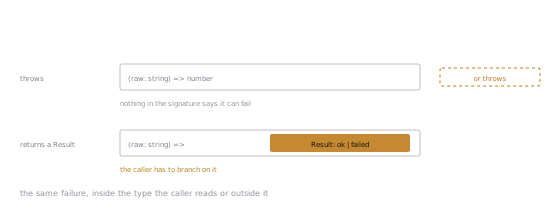
Both declarations are the same shape. The failure exists in both; the difference is whether it falls inside the box the caller reads.
A Result shape of your own
safeParse's union belongs to Zod, and most functions run no schema, so they need a failure shape not borrowed from a validation library, the same idea lesson 22 named, written out plainly.
type Result<T, E> = { ok: true; value: T } | { ok: false; error: E };

type ParseAgeError =
  | { kind: "empty" }
  | { kind: "not-a-number"; raw: string };

function parseAge(raw: string): Result<number, ParseAgeError> {
  if (raw.trim() === "") return { ok: false, error: { kind: "empty" } };
  const n = Number(raw);
  if (Number.isNaN(n)) return { ok: false, error: { kind: "not-a-number", raw } };
  return { ok: true, value: n };
}

function describeAge(raw: string): string {
  const result = parseAge(raw);
  if (result.ok) return `age is ${result.value}`;
  switch (result.error.kind) {
    case "empty":
      return "no age given";
    case "not-a-number":
      return `"${result.error.raw}" is not a number`;
    default: {
      const _e: never = result.error;
      return _e;
    }
  }
}
Run against "30", "" and "abc" and this prints age is 30, no age given and "abc" is not a number. Result<T, E> is two arms and nothing more, no map, no andThen, no chain for threading it through several calls unwrapped; libraries add that machinery, and building one is a stage beyond this.
The typed error is the point, not the wrapper
The never guard on result.error.kind works only because ParseAgeError is literal kinds. Add a third kind, { kind: "negative"; value: number }, and use it in parseAge without touching describeAge's switch.
error TS2322: Type '{ kind: "negative"; value: number; }' is not assignable to type 'never'.
The build breaks at the switch that stopped being exhaustive, lesson 23's proof again, now protecting a failure type. Change Result<number, string> instead, every failure just a message, and add the same reason as a plain string.
if (n < 0) return { ok: false, error: "negative" };
This compiles with no error anywhere, even though nothing in describeAge recognises "negative", which falls through to a generic "invalid age". A string carries no structure to reason about, so there is nothing for a never guard to check; the same is true of a bare Error. Literal kinds give the guarantee lesson 23 built; Error or string give a place to put a message and nothing more.
When to throw anyway
A lesson that says never throw would be wrong, and ignored for being wrong. Throw for a programmer error the immediate caller cannot sensibly act on, such as a call that violates a declared precondition, or an invariant already broken, where continuing computes a wrong answer from a program no longer in a state anyone reasoned about. Throwing also suits a genuine top level boundary, a place where something above catches whatever comes up and turns it into a response, a log line or an exit code, with nothing below needing to know the shape of what went wrong. Return a value for a failure that is an expected, nameable outcome, which a boundary check almost always is: a string that fails to parse as an age is not a bug, it is one of parseAge's outcomes. The test is short: can the immediate caller do something different depending on which failure occurred. If yes, it needs the failure as a value to inspect. If no, a throw loses you nothing.
The cost, stated fairly
Putting a failure in the return type puts the handling in the caller's face, and that is the point, not a side effect to apologise for, but it is still more code: every call site that can fail now has a branch a throw would have let it skip. It also composes less conveniently across several layers: an exception can cross five call frames untouched and be caught once near the top, while a Result has to be checked and passed on at every frame by hand, since no combinator was taught here. A codebase with both styles side by side is normal; the decision belongs at each boundary, using the test above, and at a boundary the answer is almost always to return a value.
The stage's criterion, half discharged
Stage 5 asked that no value enter the program unvalidated and that no assertion be load bearing. Lesson 31 put a parse at the edge; this lesson put that parse's failure in the return type, a value a caller can inspect rather than a throw a caller can ignore. Between the two, no value crosses the boundary unchecked, and no caller can fail to notice a value failed to validate, because the type it received says so.
Practice
- ▢
function assertPositive(n: number): number { if (n <= 0) throw new RangeError("not positive"); return n; }. PredictassertPositive's inferred type, and predict whetherconst x: number = assertPositive(-1);compiles.
Check
The type is (n: number) => number, with no trace of the throw. The assignment compiles with no error, since the compiler only checks that a number is assigned where one is expected, never whether the call can actually produce one; the failure shows up only at run time, as an uncaught RangeError.
- ▢ In the
describefunction usingsafeParse, thecase falsearm is deleted butcase trueand thedefaultwithconst _e: never = result;stay. Predict the diagnostic, with itsTSnumber, and say what value it names.
Check
error TS2322: Type 'ZodSafeParseError<{ id: string; age: number; }>' is not assignable to type 'never'. It names the failure result, since default now receives exactly what case false used to exclude.
- ▢ Same
describefunction, but written asif (result.success) { return ...; }with noelseand nodefaultanywhere, return type stillstring. Predict whether this compiles, and if not, say what the diagnostic fails to tell you that item 2's did.
Check
It fails with error TS2366: Function lacks ending return statement and return type does not include 'undefined'. Real, but it reports a missing return, not a missing case, and it falls silent entirely on a void return type, which is why lesson 23 built the never guard in the first place.
- ▢ Two versions of
parseAgeeach gain a"negative"failure reason, one where the failure arm isParseAgeError(literal kinds) and one where it is a plainstring. Neither caller is updated. Predict which version fails to compile, and which compiles with no error anywhere.
Check
The literal kind version fails: error TS2322: Type '{ kind: "negative"; value: number; }' is not assignable to type 'never'. The string version compiles clean, since a string carries no structure to check against, and the new reason falls silently into the caller's catch-all branch.
- ▢ Two situations: (a) an internal helper indexes an array at a position that should always be in range, but the position is out of range only because earlier code has a bug; (b) a function converts a user-typed date string into a
Date, and the string is not a valid date. Apply the test "can the immediate caller do something different if this fails" to each, and say which should throw and which should return a value.
Check
(a) should throw: the caller did not cause the problem and cannot act on it differently, since an invariant is already broken and the right response is to stop. (b) should return a value: an invalid date string is an expected outcome of parsing input, and the caller can act differently, such as showing a validation message, exactly the boundary case this lesson and lesson 31 both point at.
Real-world reps
- [ ] Find one function that throws for a condition its caller could reasonably expect, and rewrite its return type as a
Resultwith a literal kind union for the failure, then update every caller. - [ ] Find one failure currently typed
Errororstring, give it two or three literal kinds instead, then delete acasefrom whatever handles it and read the diagnostic naming the kind you removed. - [ ] Tomorrow: find one boundary in a real project, an HTTP handler or a CLI entry point, and check whether what calls into your validated code is prepared to receive a failure value, or is quietly relying on nothing ever throwing.
Going further
- Handbook, Narrowing, for the discriminated union shape and the
neverguard this lesson reuses from lessons 22 and 23 rather than re-teaching - Zod documentation, for the
safeParseresult type used here as the worked model - Effective TypeScript, for further discussion of when a thrown error is the wrong choice for an expected outcome
- Resources
Not landing? Reread the primary source at the top, since this lesson compresses it and compression is where understanding leaks. Check the glossary for any term that felt slippery.
If the lesson itself is unclear rather than the material, that is a defect: open an issue.