Coercion and Equality
Lookup sheet for stage 1. The question it exists to answer: what will this value do in a comparison or a condition?
The types
| Primitive | Notes |
|---|---|
undefined | produced by the language: unassigned, missing, not passed |
null | written by a programmer to mean deliberately empty |
boolean | |
number | 64-bit float; integers exact only up to 2^53 - 1 |
bigint | arbitrary-precision integers, not mixable with number |
string | immutable, UTF-16 code units |
symbol | unique property keys |
Everything else is an object, including arrays, functions, Date, Map and RegExp.
typeof, and where it lies
| Expression | Result |
|---|---|
typeof undefined | "undefined" |
typeof null | "object", a historical wart |
typeof [] | "object"; use Array.isArray |
typeof (() => {}) | "function" |
typeof NaN | "number" |
typeof 1n | "bigint" |
Falsy values
false, 0, -0, 0n, "", null, undefined, NaN.
Everything else is truthy, including "0", "false", " ", [], {}, and every function.
[] and {} being truthy is the one that surprises. For "has items", write items.length > 0.
== against ===
=== compares type and value, with no conversion. == converts first.
| Expression | == | === |
|---|---|---|
1 == "1" | true | false |
0 == "" | true | false |
0 == "0" | true | false |
"" == "0" | false | false |
0 == false | true | false |
[] == false | true | false |
null == undefined | true | false |
null == 0 | false | false |
NaN == NaN | false | false |
== is not transitive: 0 == "" and 0 == "0" hold while "" == "0" does not.
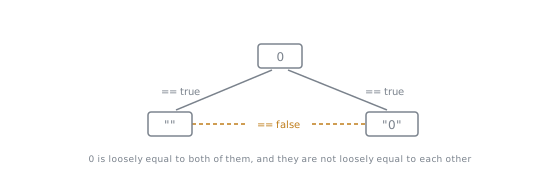
Three rows of the table above, drawn as the shape they make. A relation that fails to close like this cannot be used to reason with: knowing a == b tells you nothing you may carry to c, so no chain of == comparisons is safe to follow even when every individual row of the table looks harmless. That is the argument for the rule below, rather than a list of surprising pairs to memorise.
Rule: use === everywhere, with one exception: x == null tests for null or undefined in one operator and is idiomatic.
Special comparisons
| Need | Write |
|---|---|
is it NaN | Number.isNaN(x) |
is it null or undefined | x == null |
distinguish -0 from 0, or match NaN | Object.is(a, b) |
does an array contain NaN | arr.includes(NaN), not indexOf |
| compare objects by contents | no built-in; write it or use a library |
indexOf uses ===, so it never finds NaN. includes uses SameValueZero, so it does.
Defaults and access
| Operator | Falls back on | Use when |
|---|---|---|
a \|\| b | any falsy a | 0, "" and false are not valid values |
a ?? b | null, undefined | almost always |
a?.b | short-circuits on null, undefined | the object may be absent |
a \|\|= b, a ??= b | same rules as above | in-place assignment |
The logical-or default is the most common live bug in a TypeScript codebase, because 0, "" and false are ordinary values in most domains.
Numbers
| Expression | Result |
|---|---|
0.1 + 0.2 === 0.3 | false |
0.1 + 0.2 | 0.30000000000000004 |
Number.MAX_SAFE_INTEGER + 2 | not distinguishable from + 3 |
parseInt("08") | 8 |
Number("") | 0 |
Number(" 12 ") | 12 |
Number("12px") | NaN |
parseInt("12px") | 12 |
For money and identifiers, use integers of the smallest unit, strings, or bigint. Never a float.
Reviewing a condition
- What are the falsy values of this type? If
0or""is one of them,||is suspect. - Is the comparison
==? If so, is it thex == nullexception, and if not, replace it. - Is either side possibly
NaN? Then no comparison operator works, andNumber.isNaNis the test. - Are both sides objects? Then
===compares identity and the code probably wanted contents.