Judgment
Lookup sheet for stage 7. The question it exists to answer: which edit breaks a consumer, whose settings decided what a declaration is allowed to claim, and which construct still leaves something running once the type is gone?
Edit to verdict
An edit is safe exactly when every program that compiled against the old type still compiles against the new one, a question about assignability in a fixed direction, not about how large the edit looks on a diff. See lesson 43.
| Edit | Direction | Breaks a consumer | Diagnostic if it does |
|---|---|---|---|
Parameter widened, string to string \| number | contravariant, safe | No | none |
| Parameter narrowed back down | contravariant, unsafe | Yes | TS2345 |
Return type narrowed, string \| number to string | covariant, safe | No | none |
| Return type widened further | covariant, unsafe | Yes | TS2322 |
| Property added, optional | safe | No | none |
| Property added, required | unsafe | Yes | TS2741 |
| Union member added to a returned union | breaks an exhaustiveness guard | Yes | TS2322, against the guard's never |
| Union member added to an accepted parameter's union | safe, same reasoning as widening | No | none |
| Removing a function, property, or exported type | no direction to check | Yes | TS2305 |
| Renaming a published type, shape unchanged | looks safe, is not | Yes | TS2305; an import asks by name, shape does not answer that |
Tightening a loose type to the truth, any to a real narrower type | looks safe, is not | Yes | TS2322; compatibility and correctness are separate |
Publishing checklist
Three checks, run in order. See lesson 44.
- Generate. Compile with
declarationset, andemitDeclarationOnlytoo if a separate step already produces the JavaScript, then open the.d.tsthe compiler actually wrote. - Resolve from a scratch consumer. Build a second, real package with its own
package.jsonandtsconfig.json, install the library the way a real consumer would, and import the names a consumer would. - Read the declaration. Go through the
.d.tstop to bottom, asking of every exported function whether each type it mentions is a primitive, exported by name, or accepted as unnamed.
Step 1 confirms only that the source type checks; step 2 only that resolution worked. Only step 3 catches a surface wider than intended, since a dragged-in internal type compiles as cleanly as a deliberately exported one. Step 2 is more forgiving than expected: with no types field and no exports map, resolution still finds a .d.ts beside whatever main names, the same fallback lesson 21 covers for a specifier missing its extension. The field only matters once that fallback finds nothing too, for example once a build moves the declaration file without updating a types condition; the consumer then gets the same TS7016 a dependency shipping no declarations at all would produce.
What the surface includes
An exported function's signature drags in every type it mentions, whether or not the author meant to publish that part; leaving it unexported removes only the name a consumer could use to write an annotation with. See lesson 44.
| Situation | What is public | What is missing |
|---|---|---|
| A type declared but never exported, reachable only because an exported function's signature mentions it | the shape, checked in full against any value a consumer passes | the name; import { T } from "pkg" fails with TS2459 |
The author's settings are part of the contract
The stage's sharpest finding, verified end to end: a loose author setting publishes a false declaration that no consumer's own strictness can detect, since the wrongness was baked in before the declaration reached them. See lesson 45.
| Author's setting left off | What a loose value publishes | What a consumer can do | What a consumer cannot do |
|---|---|---|---|
strictNullChecks, part of the strict family | a return type such as string where the implementation can return null | parse or narrow at the boundary, per lesson 31, or patch the declaration with a dated comment | turn on their own strict; it governs code the consumer writes, not an imported declaration |
noUncheckedIndexedAccess | an indexed return typed string where the bound is unchecked, so it can be undefined | the same parse, narrow, or dated patch | turn on their own copy of the flag; the indexing already happened inside the library, out of the consumer's code |
| both, at once | two false claims behind one clean, confident declaration | treat the dependency as an unaudited boundary, the only real verification | reach for skipLibCheck; verified both ways, it checks a .d.ts for internal consistency, never against the implementation |
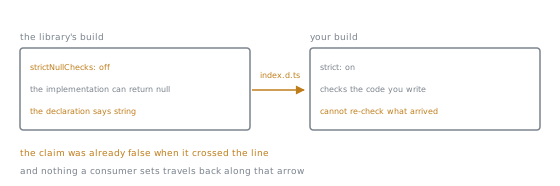
The last column of the table is a consequence of the arrow. A consumer's flags are not weaker than the author's, they are pointed at different code: everything to the right of the line. The declaration was already false to the left of it, and there is no second arrow going back.
A tsconfig.json behind a published package reads as a private build detail, but it decides which claims in the declaration are backed by a check, which makes it part of the interface whether a consumer reads it or not.
What does not erase
erasableSyntaxOnly names, in the compiler's own words, what it exists to refuse: "Do not allow runtime constructs that are not part of ECMAScript." A construct fails it exactly when compiling it invents JavaScript beyond the plain expression underneath. See lesson 46.
| Construct | Verdict under erasableSyntaxOnly | Write instead |
|---|---|---|
enum Colour { Red, Green } | TS1294 | a union of string literals, type Colour = "Red" \| "Green", unless the reverse mapping or iteration is genuinely used |
const enum E { A = 1 } | TS1294, no exemption despite being advertised as inlined | the same union |
namespace N { ... } | TS1294 | an ordinary module, import and export |
constructor(private x: number), a parameter property | TS1294 | the assignment written by hand, this.x = x; |
| a standard decorator on a class method | compiles, no diagnostic | nothing; legitimate as written |
The decorator row differs because a standard decorator is itself an ECMAScript feature, so the code it produces is JavaScript's own semantics, not a TypeScript invention, exactly the flag's line. The trap runs the other way: the same decorator under the older experimentalDecorators flag fails with TS1241, expecting the pre-ECMAScript calling convention; the fix is migrating the flag off, not the decorator. If the reverse mapping or iteration is genuinely needed, an as const object paired with a derived type, (typeof Colour)[keyof typeof Colour], keeps a real value without the unwanted mapping, though it still lacks the numeric reverse lookup.
Which source answers which question
TypeScript has no specification; an early attempt was abandoned years ago and nothing replaced it, so the compiler is the definition and every other document is commentary about what it does. See lesson 47.
| Question | Answer sits here |
|---|---|
| Did this change, and in which release | the release notes, recording what became true on a given date, not what is true today |
| What a construct actually does, rather than what it is supposed to do | the compiler's own shipped lib files, written by the same team that writes the checker enforcing them |
| Why the compiler behaves this way, when neither of the above says | the issue archive, a record of intent at a point in time, not of current behaviour |
| What happens right now, definitively | write the two lines and run the compiler you actually have; nothing outranks it |
| A general description, aimed at teaching rather than at stating every rule | the Handbook, which can lag the compiler it describes |
When a Handbook citation and a compiler diagnostic disagree, the diagnostic wins, and the review comment should quote it rather than paraphrase the page.
Review
The method names three things rather than a reaction: what a construct costs, as a fact about the code; who pays; and what the alternative looks like. "This looks complicated" fails all three and gives the author nothing to fix. See lesson 48.
- A conditional type. Compare what the caller writes, and sees when wrong, against a plain generic doing the same job; wrong when the plainer alternative buys the same guarantee with a legible error, right only when the caller is measurably better off for having nothing left to narrow.
- An assertion. Ask what it claims, what establishes the claim, and if nothing does, what would; a defensible assertion carries a comment stating a checkable fact, and one without stands in for a check that never ran.
- An
enum. Point at the mutable object with the reverse mapping it builds, the evidence lesson 46 verified in the emitted output, and ask whether the diff reads either direction of it; if not, a union of literals covers it and erases completely, and if iteration or the reverse lookup is genuinely needed, offer theas constfallback rather than repeat "avoidenum" as a slogan. - The shorter catches. An
anywith no comment removes checking from everything built on it. A type predicate whose body does not test itsisclaim is trusted at every call site. A value crossing a boundary unparsed needs a schema check, not an assertion standing in for one. A hard-to-change published signature is lesson 43's territory: who rebuilds against it, and on what schedule.
"It compiles" is never an answer to a named cost, since every construct above compiles cleanly while doing exactly the damage described; a reply worth having names what the construct buys a caller that the alternative does not, or accepts the rewrite.
Diagnostics seen in this stage
TS number | Meaning | Usual cause |
|---|---|---|
TS1241 | unable to resolve a method decorator's signature | a standard decorator compiled under the legacy experimentalDecorators flag |
TS1294 | syntax not allowed under erasableSyntaxOnly | an enum, a const enum, a namespace, or a parameter property |
TS2305 | module has no exported member | an export removed, or a published type renamed with its shape unchanged |
TS2322 | not assignable | a narrowed parameter, a widened return type, a union member left over against a never guard, an inherited false return type, or a conditional type's own alias reported back unresolved |
TS2345 | argument not assignable | a published parameter narrowed back down |
TS2459 | module declares a name locally, but it is not exported | an unexported type reachable only through an exported signature |
TS2741 | required property missing | a required property added to a published interface |
TS7016 | could not find a declaration file for a module | a missing types field with no fallback present, or a types condition pointing where the file no longer sits |