Modelling
Lookup sheet for stage 4. The question it exists to answer: which shape removes the illegal state, and which declaration catches the mistake where you made it?
Shape to state count
| Shape | States permitted | Replace with |
|---|---|---|
Two optional fields describing alternatives, a?: X; b?: Y | product of each field's presence and absence, four for two fields | a discriminated union, one arm per domain state, tagged by a literal discriminant. See lesson 22 and lesson 24 |
A flag beside the data it governs, loading: boolean; data?: T; error?: string | product of every field's own count, eight for three independent fields | one union arm per domain state, so each field is read only after checking which arm is held. See lesson 24 |
A field whose legality depends on another, method: "pickup" \| "delivery"; address: string | same count as if independent, since nothing stops the disallowed pairing | move the dependent field into only the arm that needs it. See lesson 24 |
A discriminant declared as string rather than a literal | as many as a correct union would have, since a check against it eliminates nothing | narrow the field to the literal union it should have been. See lesson 22 |
A bare primitive with a range or format the domain restricts, price: number | one state, since counting fields finds nothing to remove | a brand asserted once at construction, or validation at a boundary, stage 5's material. See lesson 24 and lesson 25 |
The method behind every row above: count what the type permits, count what the domain produces, and if the first number is larger, name the difference and remove it. See lesson 24.
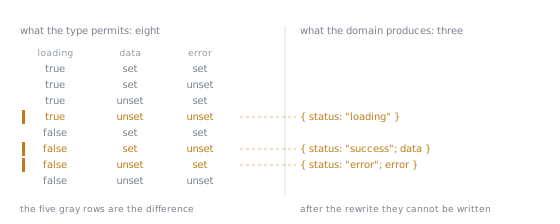
The method run on the second row of the table, with the counts from lesson 24: eight permitted, three produced. The five with no arm beside them are the difference, and they are not exotic. { loading: true, data: "x", error: "oops" } is one of them, and it compiles.
Discriminated union anatomy
| Requirement | What satisfies it |
|---|---|
| A shared property | every arm of the union declares it |
| The discriminant's type | a literal, not the general string, so a comparison against one value actually eliminates the other arms |
| The discriminant's value | a different literal in every arm, with no overlap between arms |
| The name | any identifier works, kind, type, status and tag all appear in real code; consistency across a codebase matters more than the name chosen |
See lesson 22.
Exhaustiveness
The never guard | No guard | |
|---|---|---|
| Where it goes | default of a switch, or a final else, assigning the selector to const _e: never | relies on the declared return type alone |
| What it reports when a member is unhandled | the exact value or shape left over, by name, as TS2322, or TS2345 through a helper such as assertNever | TS2366, a return statement is missing, not which case caused it |
| What it misses | nothing forces anyone to write the guard | fires only when the return type demands a value on every path; a void function gives no diagnostic at all for an unhandled case |
See lesson 23.
Brands
| What a brand blocks | What it permits | Where the assertion belongs |
|---|---|---|
A plain value of the underlying primitive, or a different brand of the same primitive, from being passed where the brand is required, TS2345 | the branded value flowing out to the underlying type for free, in an assignment or a method call, since every operation the primitive supports still works | inside the one function that establishes the invariant, written once, never repeated at a call site |
Checked at compile time only: the property a brand adds is erased by run time, so nothing distinguishes a careful assertion from a careless one except which function wrote it. See lesson 25.
Generics
A type parameter earns its place when both are true:
- it appears more than once, tying together two or more positions such as a parameter and the return type
- a call site can infer it from an argument, so nobody has to spell it out by hand
Two signals that it does not:
- it appears exactly once. A concrete type or a union says as much as
Tdid - no call site can ever infer it. Every caller must write the type argument by hand, so the parameter saved nothing
See lesson 26.
Check a value: the three forms
| Form | Checked against the type? | Inferred type kept? |
|---|---|---|
annotation, const c: T = value | yes | no, c becomes T itself |
satisfies, value satisfies T | yes | yes, c keeps whatever the literal would have inferred alone |
as, value as T | no | not applicable, the written type is asserted rather than checked |
satisfies buys nothing on a value already typed any, since any passes trivially and has no narrower type to keep. See lesson 27.
interface or type
| Question | interface | type |
|---|---|---|
| Names an object shape | yes | yes |
| Names a union, a tuple, or a primitive alias | no syntax for it, TS1005 | yes |
| Two declarations sharing a name | merge into one | TS2300, duplicate identifier |
| Extending, with a conflicting member | rejected at the declaration, TS2430 | compiles; the conflicting property becomes never, and construction fails later at whichever call site builds a value |
| Takes a type parameter | yes | yes |
| Erased at run time | yes | yes |
The decision rule, first line that applies wins: not an object shape, use type; public and may need extending by other code, prefer interface, since only it merges; built by extension where a conflict should be caught at the declaration, prefer interface extends over &; otherwise either works, and matching the codebase's existing choice matters more than which one is picked. See lesson 28.
Diagnostics seen in this stage
TS number | Meaning | Usual cause |
|---|---|---|
TS1005 | a token such as { or , was expected | interface written as a union, or satisfies in a parameter position |
TS1144 | { or ; expected | satisfies written where a return type belongs |
TS2300 | duplicate identifier | two type aliases sharing a name, where two interface declarations would have merged instead |
TS2322 | not assignable | a member left over in a never assignment, a missing member on the matched arm, a plain value assigned to a branded type, a satisfies mismatch, or a conflicting intersection member found at construction |
TS2339 | property does not exist | reading a member only one arm has without narrowing, a non-literal discriminant, or an unconstrained type parameter's body |
TS2345 | argument not assignable | a widened discriminant passed as an argument, a call into assertNever, a mismatched brand, or a constrained generic called with the wrong type |
TS2353 | excess property on a fresh literal | a value naming a member that belongs to a different arm, whether checked by an annotation or by satisfies |
TS2365 | an operator cannot be applied | an unconstrained type parameter used with an operator not every type supports |
TS2366 | function lacks an ending return statement | a switch with no default and an unhandled member, under a non-void declared return type |
TS2430 | interface incorrectly extends interface | interface extends inheriting a member whose type conflicts with the base |