Type-level Tools
Lookup sheet for stage 6. The question it exists to answer: which construct computes which type, and the test a clever one has to pass?
Which construct for which job
| Construct | What it computes | The one-line case for it |
|---|---|---|
| Mapped type | A new object type, one property per key of another type | A "partial update" or "getters" shape that stays in step with its source. See lesson 36 |
| Conditional type | A type chosen by an assignability test, decided fresh on each use | A return type that depends on the caller's argument, with nothing left to narrow or assert. See lesson 37 |
infer | A blank inside a conditional type's extends pattern, bound to whatever matched there | A wrapper's return type that tracks the wrapped function's own, instead of a second type argument. See lesson 38 |
| Template literal type | A backtick pattern in type position, each ${...} holding a type instead of a value | An event name where a typo is rejected at the call, not a handler that silently never fires. See lesson 39 |
The four compose: a template literal type can sit inside a key remapping, and infer inside any conditional type's pattern.
Mapped type syntax
| Form | Written | Effect |
|---|---|---|
| Iteration | { [K in keyof T]: T[K] } | one property per key of T, value unchanged |
| Add a modifier | { [K in keyof T]?: T[K] } | every property becomes optional |
| Remove a modifier | { -readonly [K in keyof T]-?: T[K] } | strips readonly and ?; Required strips only -?, the same trick |
| Key remapping | { [K in keyof T as `get${Capitalize<string & K>}`]: () => T[K] } | the key changes; string & K guards against a key that is a number or symbol |
| Filtering | { [K in keyof T as Test extends true ? K : never]: T[K] } | remapping a key to never removes it, which is how a mapped type selects rather than only transforms |
See lesson 36.
Conditional types
| Question | Answer |
|---|---|
| Form | T extends U ? X : Y, a question about assignability, re-asked at every use rather than declared once |
never as the empty branch | one arm produces nothing; a union that absorbs a never member is the same union with that member gone |
| Distribution over a union | a naked type parameter on the left of extends, substituted with a union, runs once per member and unions the results back together |
| Switching distribution off | wrap both sides in a one-element tuple, [T] extends [U] ? X : Y; the union is then tested once, as a whole |
| Built from exactly this | Exclude, Extract and NonNullable: ordinary conditional types, no separate mechanism |
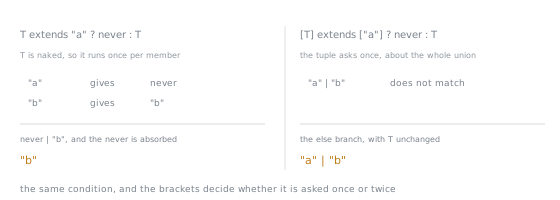
Three rows of the table above, run as one worked example: distribution, the never that gets absorbed, and the tuple that switches distribution off. Nothing in the condition changed between the two sides, and neither did T. The brackets alone decide whether the question is asked about the members or about the union, and that is the difference between "b" and "a" | "b".
See lesson 37.
infer positions
| Position | Captures | Standard-library type built on it |
|---|---|---|
Return position, (...a: never[]) => infer R | the function's return type | ReturnType |
Parameter list, (...a: infer P) => any | the whole parameter list, as a tuple | Parameters |
| A promise's inner type, matched recursively | the eventually resolved type | Awaited, using infer more than once |
An array pattern, (infer E)[] | the element type | not named, same shape |
A tuple slot, [infer H, ...unknown[]], optionally infer H extends string | one element, matched only if it satisfies the constraint | not named; the constraint decides whether the pattern matches |
A slot inside a template literal, `on${infer E}` | the captured slice of the string literal | not named, same binding behaviour |
See lesson 38.
Variance
| Position | Variance | Reader-facing consequence |
|---|---|---|
| Return type | covariant | a function returning a narrower type may stand in for one declared to return something wider |
| Function parameter, written as a property | contravariant | a handler narrower than the promised parameter is rejected, TS2322 |
| Function parameter, written as a method | bivariant | neither narrowing nor widening is caught; a deliberate exemption, not an oversight |
| A type parameter used in both a getter and a setter | invariant | must match exactly, since no direction of substitution is safe for both positions at once |
| Array element type | covariant, and unsound; this is deliberate | a narrower array assigned to a wider name can be mutated through that name, and the narrower name then reads a value its own type never promised |
Variance annotation, in, out, or both | documents variance the checker already computes | a hint to the checker and to a reader, not a new capability; a wrong claim is caught, at the declaration, as TS2636 |
See lesson 40.
Signature design
- A type parameter is inferred when it appears in a parameter position the call actually fills, fixing it before the return type is considered.
- A type parameter is not inferred when it appears only in the return position, or the function is called with no arguments; every call then needs it written by hand.
- First signal a signature is wrong: the caller must write the type argument on every call, costing exactly what an explicit cast would have cost.
- Second signal a signature is wrong: a wrong call's error names the type's own machinery, such as an intermediate alias, rather than the caller's mistake.
conston a type parameter moves the cost of keeping a literal type, otherwiseas constat every call site, into the signature, paid once by the author.
See lesson 41.
Cost and limits
| Question | Answer |
|---|---|
| How to measure | tsc --diagnostics or --extendedDiagnostics for a summary; --generateTrace to find the responsible type once the summary says something is worth chasing |
| What to read | the instantiation count, not check time; instantiations grow without bound as recursion or a union grows, while check time can stay small for a while |
| The exact ceiling | a tail-recursive tuple-building type compiles at a target length of 999, fails at 1000 with TS2589, and the ceiling held again at 1500 |
| Why check time is the weaker argument now | close to half a million instantiations checked in under half a second; "will slow the build down" now needs a --diagnostics run behind it |
| The stronger argument | maintenance: a long, truncated error against a clever type costs every reader, whether or not the build itself is fast |
See lesson 42.
The stopping test
- Cover the type's definition, look only at where it is used, and say what it evaluates to for a new input, in under a minute.
- Name the caller plainly: a colleague reviewing the change, or the same author in six months, having forgotten today's trick.
- Ask what that caller writes, and what they see when they get it wrong; a signature can satisfy the first and still fail the second.
- If a technique cannot be tied to a caller who writes less, gets a better error, or cannot make a mistake they could otherwise make, it does not earn its place.
Diagnostics seen in this stage
TS number | Meaning | Usual cause |
|---|---|---|
TS2322 | not assignable | the survivor a conditional type computed, a rejected template literal pattern, or a mismatched infer capture |
TS2339 | property does not exist | a key remapped to never, or a property a filtering mapped type dropped |
TS2345 | argument not assignable | a callback narrower than a promised parameter, or a key a conditional type rejected |
TS2589 | type instantiation excessively deep | recursion past the compiler's depth limit, exact at 1000 for a tail-recursive tuple build |
TS2636 | contradicts a stated variance annotation | in or out claimed on a generic not actually used that way |
TS2741 | required property missing | a mapped type computed from a type that has since grown a field |
TS18046 | value is of type unknown | a type parameter with nowhere in the call to infer it from |